
Query Fan-Out: Find the Answers Missing From Your Local Business Pages
One search question can lead to several related questions. Plan useful content, compare page gaps and give customers clearer answers without chasing a made-up AI ranking score.
By local-SEO.com Editorial Team · Published · 6 min read
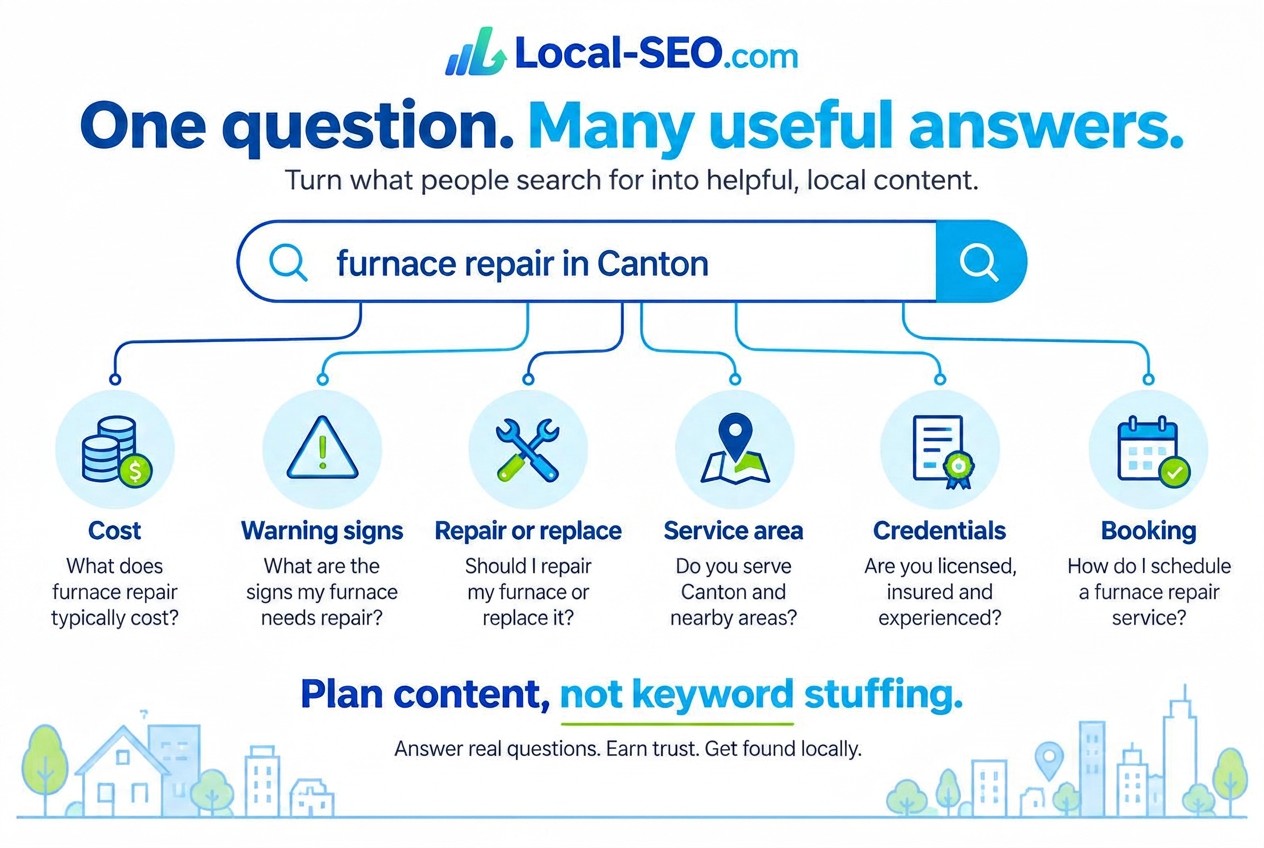
A customer searches for “furnace repair in Canton.” The decision behind those words is rarely just “find a company.” They may need to know why the furnace stopped, whether a repair makes sense, what affects the price and whether someone serves their neighborhood.
A page that only repeats the search phrase leaves those questions unanswered. Query fan-out offers a useful way to think about the missing information.
Open the free AI query fan-out mapper to explore related questions and compare page coverage.
What is query fan-out?
Query fan-out describes breaking an initial question into related searches across subtopics. Google’s AI search experiences may use this approach to gather information for an answer. It is not a fixed sequence that every search follows, and different AI products do not necessarily work the same way.
For a local business, the practical lesson is to answer the decision your customer is making, not just the phrase they typed. A furnace repair query could connect to symptoms, safety, repair versus replacement and service coverage. These are possible research directions, not a record of searches an AI system actually performed.
What our free mapper shows
The Local-SEO.com mapper uses AI to suggest related questions and organize them into topic groups. Each question includes a suggested heading, the information an answer would need and a possible place for it on a page.
You can check a public page address or paste its main text. Enable the competitor comparison to check both pages against the same questions. Export the map and results if you want to keep a copy.
The map is a planning aid. It does not expose Google’s internal searches, measure search volume, report your AI position or prove that adding a topic will earn a citation. Suggestions can miss important questions or include ones that do not fit your service. Review them before acting.
The tool is free without an account. Each visitor has three runs per UTC day. A map counts as one run; checking one page or comparing two pages counts as another. No monthly account credits are charged.
Start with a customer decision
Use a focused query such as “furnace repair in Canton,” rather than a broad word like “heating.” Add the location when it changes the customer’s needs.
Consider Maple Leaf Plumbing & Heating, a fictional business in Canton, Ohio. Its page might explain which furnace problems it handles, how an assessment works and how customers can ask about an appointment. The business must confirm those details before they appear on a live page.
Reject suggestions about services you do not offer. A residential furnace repair page does not need industrial boiler content merely because a mapper suggested it.
Build around answers, not keywords
A useful service page could include:
- A direct opening: the service, provider and actual location or service area.
- When the service is relevant: common problems and limits, explained accurately.
- What happens next: the real assessment, quotation or booking process.
- Cost factors: what changes the price. Publish specific prices only when confirmed.
- Evidence: original work examples, relevant qualifications and accurate business details.
- Service coverage: locations you genuinely serve, without interchangeable city text.
- Customer questions: short answers to remaining decisions.
- A next step: a real contact or booking option.
This is an editorial starting point, not a required AI-search template. A product page, visitor attraction and professional service need different information.
Read our service-page guide for a more detailed page-building approach.
Find an answer gap
After generating a map, enter a public page address or paste at least 80 characters of content. The tool reads available text without running page scripts. If a page blocks access or depends on JavaScript, paste its main text instead.
Results label each question covered, partial or missing. Covered and partial findings include a verifiable excerpt from the analyzed text. A keyword mention alone should not count as a substantive answer.
A missing label means an answer was not found in that extract. It is not proof that the answer is absent from the whole website. Look at how much text was analyzed and whether the extract was truncated.
The percentage is a heuristic summary: covered contributes one point, partial contributes half a point and missing contributes none. It is not an SEO score or predicted ranking.
Read the evidence before changing anything. If a useful answer lives on another page, an internal link may be better than copying it into every service page.
Compare without copying
Checking the same questions makes differences between two pages easier to review. But a competitor answering more suggested questions does not prove they rank better or provide a better service. Some questions may be irrelevant; your page may contain stronger first-hand evidence.
Ask: Have they explained a decision we skipped? Is our explanation clearer? Can we provide real experience or local detail that their page lacks?
Do not copy wording, reviews, claims or photographs. Use the gap to explain your own business accurately.
Your business identity needs corroboration
Your website is not the only place customers and search systems encounter your business. Keep name, address and phone details consistent on your website, Business Profile and relevant listings. Categories, services, products and descriptions should corroborate the same facts.
Start with the local chamber of commerce, then consider suitable local and industry directories. Our directory finder includes Top Ten Ohio, YOURSTARK, Discover Amish Country, USA Manufacturers Directory and Ohio Manufacturers Directory. Choose sources that match your location and industry. A plumbing business does not belong in a manufacturing directory simply to obtain another listing.
Accurate listings provide more NAP sources and can help search systems connect references to the same entity. They do not guarantee AI citations. Submissions and corrections remain manual.
Read about directories, citations and consistent business information.
Do not create a page for every question
Several questions can belong on one coherent page. A separate page makes sense when it answers a distinct need and you can provide genuinely useful information.
Avoid city-name substitutions, padded FAQs and adding topics just to raise a percentage. A shorter page with an honest answer can be more useful than a long page trying to cover everything.
Existing SEO fundamentals still matter for AI search: accessible pages, clear information, accurate facts and content that helps people. No special markup guarantees inclusion in an AI answer.
A practical first pass
- Choose one service page and one customer question.
- Generate a map and reject irrelevant topics.
- Check the page or paste its text.
- Pick three useful missing or incomplete answers.
- Confirm the facts needed to write them.
- Add answers where customers expect them, or link to an existing explanation.
- Record changes and review real results over time.
Try the free mapper before editing. It does not publish changes to your website or save a client report.
Planning is not measuring AI positioning
The mapper helps you decide what to explain. It does not tell you whether an assistant recommended your business today.
Use monthly AI tracking for dated observations with the questions and recurring credit cap you approve. Review sources and changes over time. Scheduled paid checks use account credits; they are not unlimited free runs.
Compare monthly software plans for rankings, AI checks and reports in one client workspace. Keep the free mapper for planning, and use actual observations to judge what happened.
Keep checking with a monthly plan
One shared credit balance for rankings, Geo-Grids, AI checks and reports. Paid actions show their cost first. Recurring checks use the per-run credit cap you approve; saved results are free to read.
A free account is a trial, not a monthly subscription. Plan prices and tool costs are shown on the pricing page.
About local-SEO.com Editorial Team
The local-SEO.com editorial team covers search and AI updates that affect local businesses and the agencies that serve them.
More articles
Have a story or tip? Write for us.